


Welcome to Gateways, where you experience the Nevi’im—the Prophets—through the teachings of Don Yitzchak Abarbanel, distilled into easy-to-follow lessons.
In this lesson, we’re going to dive into Isaiah’s guidance during a moment of political and religious decay.
We’ll cover the verses, Abarbanel’s questions, and his answers. I’ll conclude with a short takeaway. For a full background of this prophecy, please see His Story.
Jeff
Overview
The overarching intent of this prophecy is to make known the predictions that Isaiah the prophet foretold concerning the ascent of Rezin king of Aram and Pekah son of Remalyahu to wage war against Jerusalem in the days of Ahaz king of Judah, and also what he foretold regarding the coming of Sennacherib against Jerusalem and his downfall at the hand of Hezekiah his son, as well as the success of Hezekiah’s generation and the destruction of Damascus and Samaria—all of which will be explained in the verses themselves.

Photo by cottonbro studio
Verses
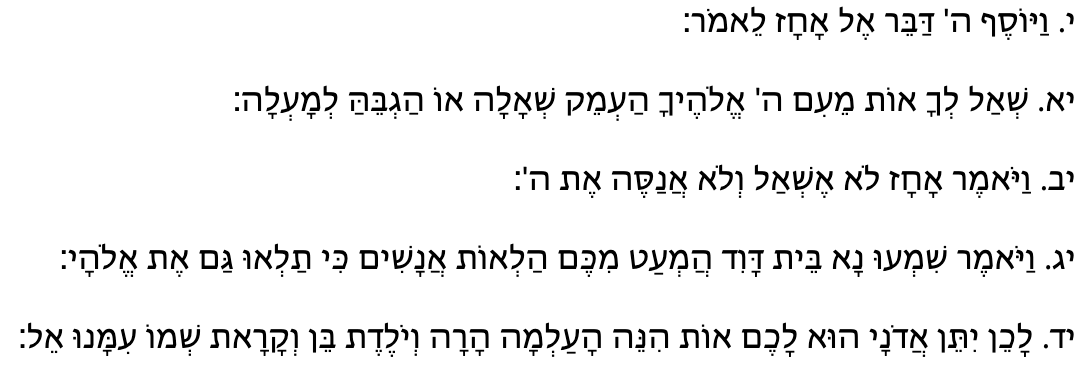
10. The Lord continued speaking to Ahaz, saying:
11. Request a sign for yourself from the Lord your God Deepen your request,or raise it above
12. Ahaz said: I will not ask and I will not try the Lord.
13. He said: Hear now, house of David: Is it not enough for you to weary people, that you weary my God as well?
14. Therefore, the Lord Himself will give you a sign: Behold, the young woman alma, will conceive and bear a son, and she will call his name Imanuel,
Question
Abarbanel identifies two reasons why, on face value, it’s okay to not ask for a sign. 1) The Torah explicitly says not to test God and 2) We are supposed to trust a verified prophet.
The third question concerns the prophet’s rebuke of Ahaz’s response, when he said, “I will not ask, and I will not test the Lord.” To this the prophet replied, “Is it not enough for you to weary people, that you also weary my God?”
Yet, on the face of it, there was nothing improper in Ahaz’s refusal to ask for a sign, for he spoke appropriately when he said, “I will not ask and I will not try the Lord,” since it is written in the Torah, “You shall not test the Lord your God” (Deuteronomy 6:17).
Moreover, there is a commandment regarding the prophet: “The man who does not listen to the words of the prophet who speaks in My name…”—all the more so here, after the prophet had already said to him, “If you do not have faith, it is because you are not faithful.” For who could hear such words and then respond afterward by saying, “I do not believe”?
And yet, Ahaz’s response is problematic.
And yet Ahaz refuses and says, “I will not ask.” Therefore the prophet says to him, “Hear now, house of David: Is it not enough for you to weary people, that you weary my God as well?” And so the Lord Himself gives a sign, even without being asked.
Answers
“Ahaz said: I will not ask and I will not try the Lord.”
This statement is not consistent inwardly with its outward appearance. For its surface meaning conveys piety and fear of Heaven—as though Ahaz truly believed the words of the prophet and therefore had no need for a sign, since a sign is only requested either to test the prophet or to test God. And since Isaiah was an established and trusted prophet, asking for a sign would indeed amount to testing God.
However, the clarification of this statement emerges from the fact that the prophet said to him: “Request a sign for yourself from the Lord your God—deepen your request or raise it above,” and Ahaz replied: “I will not ask and I will not try the Lord.”
That is to say: I will not ask for a sign, as you suggested—something that would be a limited indication or proof; nor will I test, meaning I will not require a miracle, which would be far greater. For in his view, all of this is inappropriate with respect to the Blessed Name.
This is because Ahaz believed that divine providence does not extend to particular individuals, and therefore it was not fitting, in his estimation, to trouble God—neither by requesting a sign nor by requesting a miracle—since it is not within God’s domain to oversee matters of this kind.
Alternatively, his intention may have been corrupt, even though the outward wording sounded virtuous. That is, he portrayed himself as one who believed in God’s power and therefore would not put Him to the test. Indeed, later sages explained that the commandment “You shall not test the Lord” applies specifically when a person tests God due to a lack of faith in His power, as it says, “as you tested Him at Massah,” where they said, “Is the Lord among us or not?” Similarly, this type of testing is described in “Can God provide bread as well?”
But when a person tests in order to know the will of God, as in the test of Gideon, there is no flaw whatsoever in such testing, for it is done solely to determine whether God desires to act in this manner.
Takeaway
In these verses, Isaiah is following the advice of King Solomon:
“The simpleton believes everything; the clever man considers his footsteps.”
Proverbs 14:15
It’s worth noting that Isaiah isn’t using prophecy to know what Ahaz is thinking. Instead, he’s using his intellect. He’s applying what he knows about Ahaz—that Ahaz doesn’t believe that God is aware of individual actions—and as such, Isaiah sees the lie behind Ahaz’s piety.
This story makes me consider all the ways people sometimes hide behind piety to avoid the effort of being honest.
Rabbi Greenberg, A’H, was the rabbi of my synagogue, Ezra Bessaroth, when I was growing up. Whenever he met someone and asked them how they were doing, if they said, “Baruch Hashem,” he’d retort, “pious but uninformative,” along with a small chuckle.
Of course, there might be a place for not sharing every detail of your life when someone asks how you are. Yet it’s worthwhile to go to the effort of being honest and to avoid, at all costs, hiding behind piety.