


Welcome to Gateways, where you experience the Nevi’im—the Prophets—through the teachings of Don Yitzchak Abarbanel, distilled into easy-to-follow lessons.
In this lesson, we’re going to dive into Isaiah’s guidance during a moment of political and religious decay.
For this lesson, we’re going to go deep into the overview so we can appreciate the geopolitical and religious moment that is depicted in this chapter. We’ll then see the verses, Abarbanel’s questions, and his answers. I’ll conclude with a short takeaway.
Jeff
Overview
If you’ve ever tried following Israeli politics, you’ll know how confusing it is to understand what’s happening in another country. The names, regional players, religious parties, and so much more are all foreign and often hard to follow.
I think we find ourselves in a similar situation when we try to learn the seventh chapter of Isaiah. Isaiah assumes we know the people, kingdoms, geography, and religions involved. To make matters more confusing, just one part of this story is told here in Isaiah. Other parts of this narrative come up in II Kings 16 and II Chronicles 28. So this chapter is like listening in on a specific conversation without knowing the back story.
Before we get into the particulars here, there’s something else that’s important to keep in mind. I heard this idea recently in an amazing lecture titled True and False Prophets by Rabbi Tamir Granot. In it, he mentions that while we are very clear who was a true prophet and who was a false prophet, things were not as clear to the people of that time. There are ways of demonstrating who is a true prophet.
A false prophet, however, is only known to be false when what they say doesn’t happened. Since they’re making a predication for sometime in the future, they will only be proven wrong once that point passes. So long as their prediction hasn’t been proven false, people may believe them. If the false prophet was saying things that appealed to the political leadership, it was easy for leaders to be beguiled.
Of course, there’s another layer of complexity: many people at this time believed in multiple gods. They didn’t necessarily not believe in Hashem, they might have believed in Him and other gods too.
We now have the benefit of thousands of years to be confident in our religion and faith in Hashem. Hashem performed miracles for us when leaving Egypt. He never abandoned us throughout thousands of years of exile, and we didn’t abandon Him. People in the time of Isaiah should have had supreme confidence in Hashem. Yet the feeling that perhaps Hashem would going to leave us was a common fear and adds to the moral confusion of Isaiah’s time.
With this major backdrop in place, let’s jump into the elements of this chapter so we can appreciate its story, drama, and lessons.
The People
This chapter intorduces three new people, besides Isaiah:
Ahaz son of Jotham, king of Judah. The navi describes him as “he did not do what was pleasing to God” (II Kings 16:2). He brazenly served idols. In this chapter, Isaiah rebukes Ahaz.
Pekah son of Remaliah, king of Israel. He continued in the ways of the kings of Israel in serving other gods. During his son’s reign Assyria conquered and exiled Israel.
Rezin, king of Aram, a country to the northeast of Israel.
Tiglath-Pileser, king of Assyria, a massive country quickly becoming the world’s superpower through successive successful military campaigns and expansion to the west.
The Places
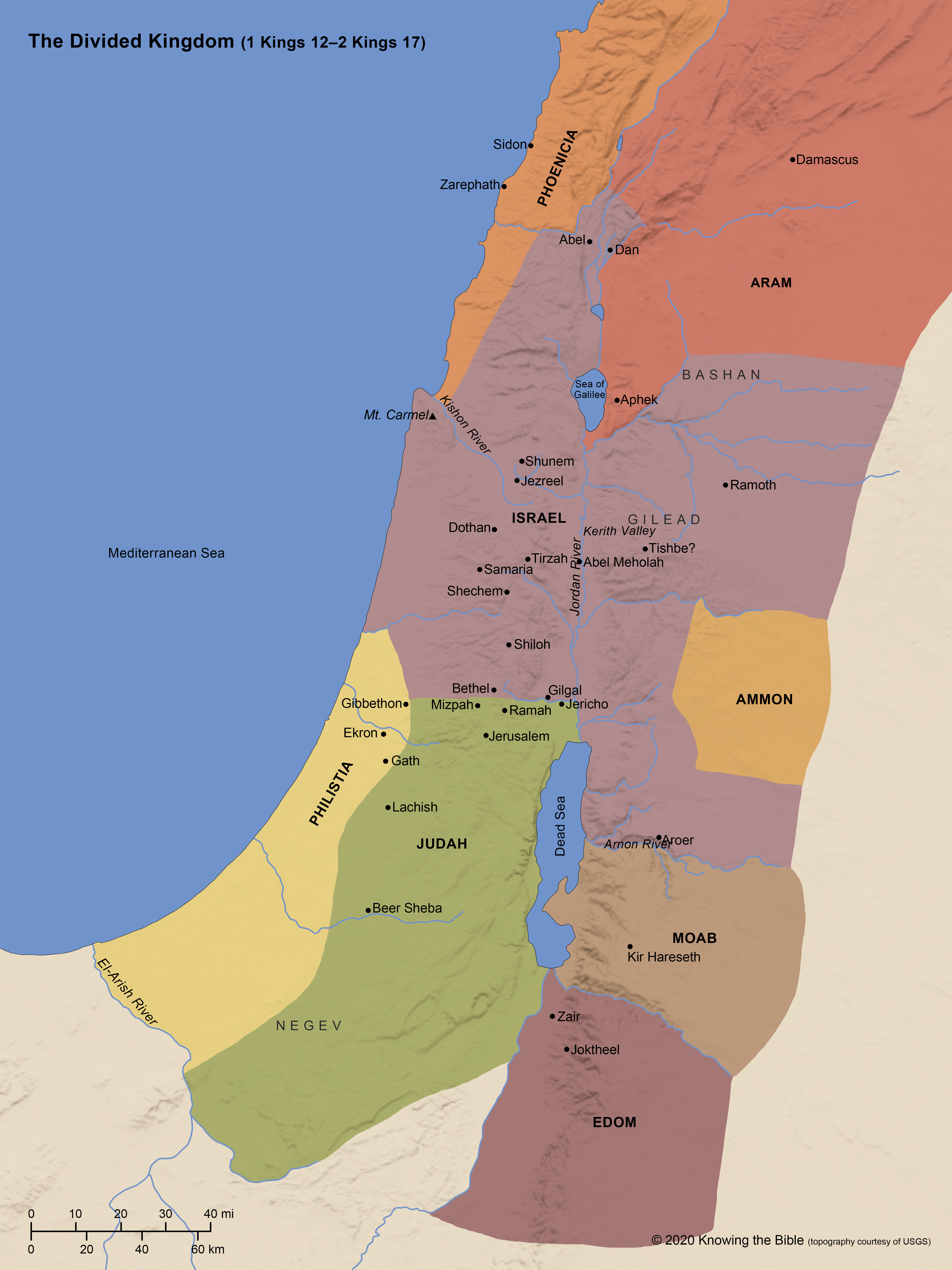
Aram is in the northeast and on the front lines of Assyria’s westward expansion. Israel is significantly larger than Judah, both in territory and in resources. Judah, as you can see, is surrounded by enemies.
What Happens
Rezin (king of Aram) and Pekah (king of Israel) join together to fight against Judah. Perhaps their political calculation was that if they had a vassal king in charge of Judah, they’d be able to fight back against Assyria. In any case, we see their political calculations as a failure of faith in God’s protection and promise.
Rezin fights against various outlying cities of Judah and conquers them, including Eilat (II Kings 16:6). This creates a situation where Judah, and Jerusalm its capital city, is surrounded by Rezin with Damascus in the north and Eilat to the south.
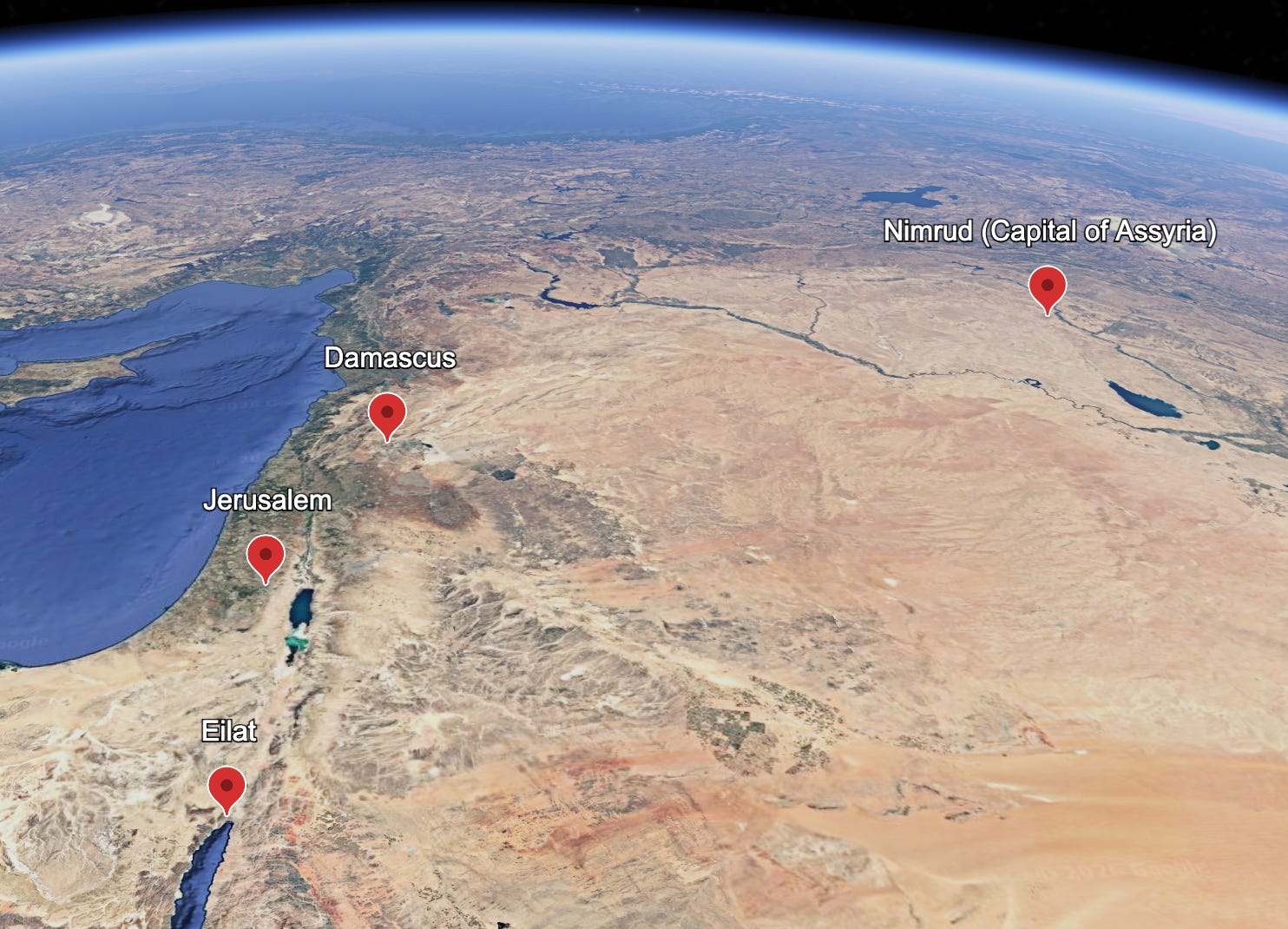
Ahaz doesn’t want to join with Rezin and Pekah. Rather than trust in God, he sends a message to Tiglath-Pileser (king of Assyria), pledges fealty to him, and begs him to protect Judah from Israel and Aram. Ahaz sends some of the Temple’s silver and gold to Tiglath-Pileser. The Assyrian king agrees and captures and kills Rezin. Ahaz figures that since Aram is so powerful, perhaps he should serve their gods instead of Hashem, “If the gods of the kings of Aram are helping them. I will sacrifice to them, and they will help me.” (II Chronicles 28:23).
This prophecy covers Isaiah’s message to Ahaz and his attempt to convince the king of Judah to have faith in Hashem.
Abarbabanel’s Overview
The overarching intent of this prophecy is to make known the predictions that Isaiah the prophet foretold concerning the ascent of Rezin king of Aram and Pekah son of Remalyahu to wage war against Jerusalem in the days of Ahaz king of Judah, and also what he foretold regarding the coming of Sennacherib against Jerusalem and his downfall at the hand of Hezekiah his son, as well as the success of Hezekiah’s generation and the destruction of Damascus and Samaria—all of which will be explained in the verses themselves.
Verses

It was in the days of Ahaz, son of Yotam, son of Uziyahu, king of Judah, that Retzin king of Aram, and Pekah son of Remalyahu, king of Israel, went up to Jerusalem in war against it, but they could not conquer it.
It was told to the house of David, saying: Aram has allied with Ephraim. His heart and his people’s heart trembled, like the trembling of the trees of the forest from the wind.
The Lord said to Isaiah: Go out now to meet Ahaz, you and She’ar Yashuv your son. to the end of the channel of the upper pool, on the path of the launderer’s field.
Say to him: Take care and be calm, do not fear, and let your heart not be faint from these two smoldering butts of firebrands used from the inflamed wrath of Retzin and Aram, and the son of Remalyahu.
Because Aram plotted evil against you, with Ephraim and the son of Remalyahu, saying:
Let us go up against Judah, sunder it, and breach it for ourselves. We will crown a king in its midst, the son of Tave’al.
So said the Lord God: It will not stand and it will not be.
Question
The first question concerns the statement, “Retzin king of Aram, and Pekah son of Remalyahu, king of Israel, went up to Jerusalem in war against it, but they could not conquer it.”
For we find in the book of Chronicles, in the account of Ahaz, the opposite of this. There its written: “The Lord his God delivered him (Ahaz) into the hand of the king of Aram, and they struck him and took from him a great captivity and brought them to Damascus; and he was also delivered into the hand of the king of Israel, who struck him with a great blow…” (II Chronicles 28:5-6) and so on.
This contradicts what is said here: “but they could not conquer it.”
Answers
Abarbanel offers two reasons for why these kings couldn’t defeat Ahaz in Jerusalem. The first—based on the midrash—is due to the merit Ahaz had from his ancestors. The second is based on the plain reading of the text: Rezin and Pekah were God’s messengers to attack certain Judean cities but not to go and destroy Jerualem. Let’s see the second reason in the text.
And the matter of this narrative is as follows: because of Ahaz’s wickedness, troubles and evils encountered him. For in the earlier days, the king of Aram, by himself, went up against his land and took from it a great captivity and brought it to Damascus, as is mentioned in Chronicles (II 28:6). And likewise Pekah son of Remalyahu, king of Israel, by himself, went up against the cities of Judah and struck them with a great blow and an enormous captivity, as is also mentioned in Chronicles.
But those wars were each one by itself. And now the two kings took counsel together—meaning the king of Aram and the king of Israel—that they would go together to wage war against the people of Judah, and not against the cities alone as they did at first, but rather that they would go up against Jerusalem, thinking that when they were joined their strength would be doubled and multiplied, and the strength of the king of Judah would not be able to stand before them, and therefore Jerusalem would inevitably be captured.
And it was among the wonders of the One perfect in knowledge that when the king of Aram went alone, or when the king of Israel went alone, they succeeded in war against the people of Judah, because each one of them individually was an agent of His providence, may He be blessed.
However, when they joined together, and the children of Israel mixed with the nations against their brothers, the people of Judah, and also because they extended their hand and their intention toward Jerusalem and toward the Temple of the Lord that was in its midst, it was from the compassion of the Lord that they did not succeed in that war…
And there is no contradiction to what is written in Chronicles, because what is mentioned there occurred on other occasions, when each of those kings went separately to wage war against the people of Judah and they succeeded in their wars, because each one acted by himself and they did not go up against Jerusalem. And what is mentioned here was on another occasion, when both of them joined together to go up at once—and with this the first question is resolved.
Takeaway
I love this story. Picture it: two kings who are full of their own egos and consider themselves masters of their universes. They have fought multiple battles against Judah and conquered many cities. The entire time they’re on their ego-fueled wars they attribute all their success to themselves and their gods, not realizing their victory was coming from Hashem to teach a lesson to Ahaz. Tragically, Ahaz never got the memo.
They then see an advancing Assyrian army and think to themselves: wow, let’s ally up with Judah. Ahaz doesn’t want to join, so Rezin and Pekah go in for regime change. They must have been supremely confident that they would capture Jerusalem.
But they can’t.
I don’t know if Rezin and Pekah ever learned humility and recognized Hashem. Yet the lesson they teach us is so clear: world events are under Hashem’s command:
לֶב־מֶ֭לֶךְ בְּיַד־ה׳ עַֽל־כָּל־אֲשֶׁ֖ר יַחְפֹּ֣ץ יַטֶּֽנּוּ׃
The heart of the king is in Hashem’s hand; He tilts it wherever He desires.
Proverbs 21:1
We don’t know why world events unfold the way they do. We only know that world events are the revelation of Hashem’s plan. It’s our gift to watch, pray, hope, and act as best as we can to be part of His story.