


This week, we read the second of the seven Haftarot of Consolation: VaTomer Tzion, from Isaiah 49:14–51:3.
It contains one of the most beautiful descriptions of the ingathering of the exiles. After explaining the verses, Abarbanel raises a remarkable question based on his understanding of the facts of the day. His answer is even more remarkable—and I think it has a great deal of resonance for us today.
The Verses
14. Zion said:
“The Lord has forsaken me;
my Lord has forgotten me.”
15. “Can a woman forget her nursing baby?
Can she fail to care for the child of her womb?
Even these may forget,
but I will not forget you.”
16. “Behold, I have etched you upon the palms of My hands;
your walls are always before My eyes.”
17. “Your children hurry back;
those who destroyed and demolished you will depart from you.”
18. “Raise your eyes around you and see:
they have all gathered and are coming to you.
As I live—declares the Lord—
you will wear them all as jewels
and bind them upon yourself like a bride.”
19. “For your ruins, your wastelands,
and your devastated land
will now be too narrow for those who dwell in you,
while those who swallowed you will be far away.”
20. “The children born during your bereavement
will yet say in your ears:
‘This place is too narrow for me;
make room for me to dwell.’”
21. “And you will say in your heart:
‘Who bore these for me?
I was bereaved and alone,
exiled and cast aside.
Who raised these?
I was left all alone—
where did these come from?’”
22. So says the Lord God:
“Behold, I will raise My hand to the nations
and lift My banner to the peoples.
They will bring your sons in the folds of their robes
and carry your daughters upon their shoulders.”
23. “Kings will be your caregivers
and their princesses, your nursemaids.
They will bow before you with their faces to the ground
and kiss the dust beneath your feet.
Then you will know that I am the Lord;
those who wait for Me will not be ashamed.”
—Isaiah 49:14–23[1]
This is an incredibly beautiful image of the Jewish people returning to their land. It is something that we, in our generation, have been fortunate to see beginning to come to fruition.
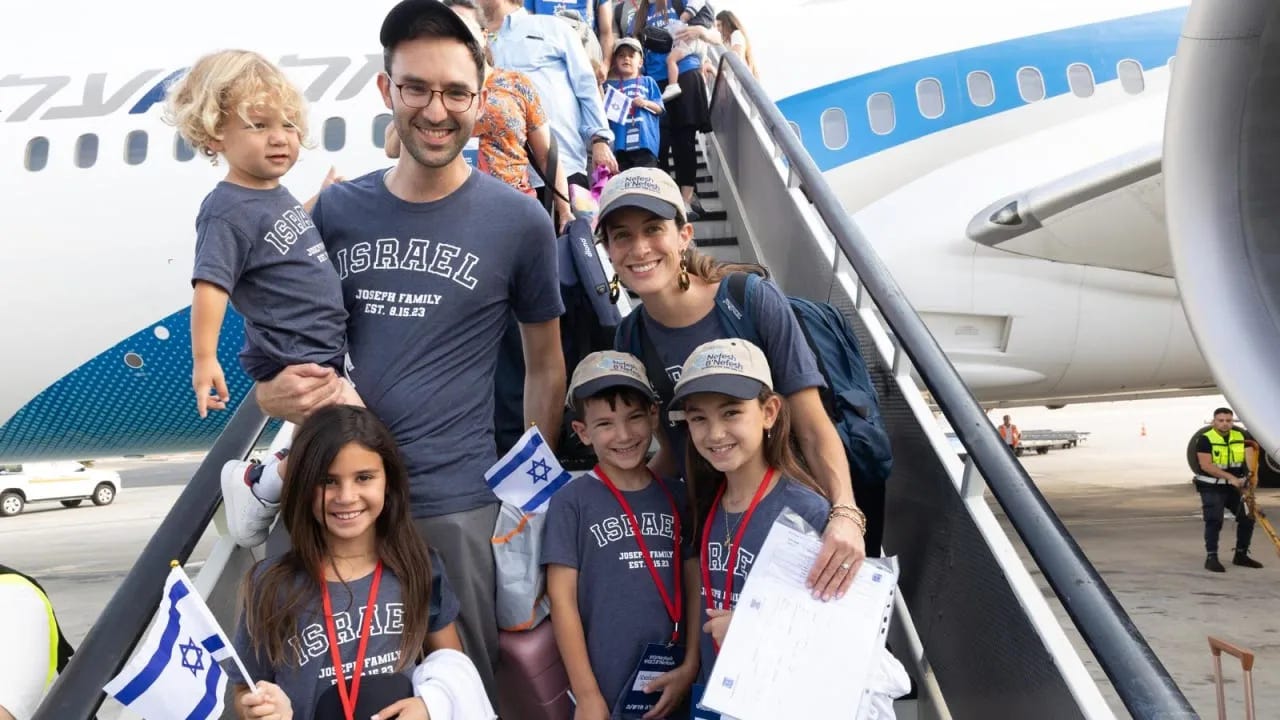
Credit: Nefesh B’Nefesh
But Abarbanel sees a problem.
Abarbanel’s Question
Abarbanel begins with the facts that were available to him.
When we examine this prophecy, he writes, it describes an extraordinary increase in the Jewish population. The returning children will be so numerous that the devastated land will become too narrow for them. They will say:
“This place is too narrow for me; make room for me to dwell.”
But in Abarbanel’s lifetime, the Jewish people were very few in number. Even if the Jews were gathered from all four corners of the earth, he argues, there were not enough of them to fill even one country. How, then, could they fill the wide and devastated Land of Israel until its inhabitants complained that there was no room?
Abarbanel considers several possible answers. Perhaps the Ten Tribes would return. Perhaps the descendants of Jews who had been forcibly converted and absorbed among the nations would rediscover their identity and return.
But even those explanations did not completely satisfy him. The verse does not merely say that many children will return. Zion asks:
“Who bore these for me?”
She had believed herself bereaved, solitary and alone. Suddenly, she finds herself surrounded by children whose origin she cannot explain.
Abarbanel’s question is grounded in the empirical reality he knew. He does not ignore the facts in order to preserve the most obvious interpretation of the verse. Instead, he asks what interpretation can account for both the words of the prophet and the reality before him.
I appreciate that approach. We are meant to test our interpretations against reality—not bend reality to fit our interpretations.
Demographic estimates from this period are necessarily uncertain, but one reconstruction by Jewish demographer Sergio DellaPergola places the worldwide Jewish population at approximately 1.3 million in 1490, around Abarbanel’s lifetime. A more recent study describes the Jewish population throughout the twelfth through seventeenth centuries as generally remaining between one million and one and a half million.[2] Abarbanel’s observation was entirely reasonable based on the facts available to him.
Abarbanel’s Answer
Abarbanel concludes that verses 18–21 are not speaking only about Jews returning from exile.
They are speaking about techiyat hametim—the resurrection of the dead.
The dead will rise and return to the Land of Israel. Regarding them, Zion will ask:
“Who bore these for me?”
They will appear as though they have just been born into the world.
The verse then asks:
“Who raised these?”
According to Abarbanel, they will rise in their full stature. No human parent will have raised them from infancy. They will emerge already grown.
Finally, Zion asks:
“Where did these come from?”
They had not previously been visible upon the earth. They had come from beneath it.
Abarbanel writes:
“There is no doubt in my mind that this prophecy was truly stated concerning the resurrection of the dead, who will come upon the Land of Israel.”
He connects this directly to Ezekiel’s prophecy:
“So says the Lord God: Behold, I will open your graves and raise you from your graves, My people, and I will bring you to the Land of Israel.”
—Ezekiel 37:12
These resurrected Jews, Abarbanel explains, will fill the Land until people say to one another:
“This place is too narrow for me.”
Only after completing this description does Isaiah begin a new section concerning the ingathering of the living exiles:
“Behold, I will raise My hand to the nations… They will bring your sons in the folds of their robes and carry your daughters upon their shoulders.”
In Abarbanel’s reading, therefore, verses 14–21 describe the resurrection, while verse 22 begins a separate description of the ingathering of the exiles. Both belong to the unfolding redemption and will occur near one another.[3]
Would Abarbanel Read It the Same Way Today?
We are now living with a very different set of facts.
The most recent authoritative estimate places the worldwide core Jewish population at approximately 15.74 million, including more than 7.15 million Jews living in Israel.[4] The Jewish people can, thank God, fill a country quite well.
My guess—and it can only be a guess—is that if Abarbanel were interpreting these verses today, the demographic question would not trouble him in the same way.
He might still understand these verses as referring to the resurrection for other textual or theological reasons. But the empirical premise that drove his interpretation has changed. The Jewish people are no longer so few that their return could not possibly fill the land.
The facts available to us today allow us to see a possibility that Abarbanel could not see: a large Jewish population returning to the Land of Israel through natural birth, migration and the ingathering of communities from across the world.
Why Not Bring Back Moshe?
Abarbanel’s interpretation also raises a fascinating question—one that he does not directly address here.
If the resurrection of the dead can occur before, during or alongside the ingathering of the exiles, why would the leader of the redemption need to be someone from our own time?
Why not bring back one of the greatest leaders in Jewish history? If we could choose between Moshe Rabbeinu, Yehoshua, King David or someone born in our own generation, it might initially seem that choosing someone from our generation would be the inferior option.
The Rambam, however, describes Mashiach not primarily by the greatness of his previous identity, but by the work he accomplishes.
He must be a king from the House of David who is immersed in Torah and mitzvot, leads the Jewish people in the path of Torah, repairs breaches in its observance and fights the wars of God. If he succeeds, rebuilds the Temple in its proper place and gathers the dispersed of Israel, then he is certainly Mashiach.[5]
Moshe or Yehoshua, despite their greatness, would not fulfill the requirement of descent from the House of David. And even King David would not be Mashiach merely because he was King David.
Mashiach is identified by what he does in bringing about the redemption.
The Rambam does not directly discuss here whether a resurrected person could theoretically become Mashiach. Therefore, Abarbanel’s interpretation cannot by itself prove that such a possibility is excluded.
But the Rambam does shift the emphasis. The question is not simply, “Who was this person in the past?” The question is, “What is this person accomplishing now?”
Why Weren’t You, You?
This reminds me of the famous statement attributed to Rabbi Zusha of Hanipol:
“In the World to Come, they will not ask me, ‘Why were you not Moshe?’ They will ask me, ‘Why were you not Zusha?’”
God does not ask one person to fulfill another person’s purpose. And perhaps He does not ask one generation to fulfill the purpose of another generation either.
Our generation is not merely what remains because the generations of Moshe, Yehoshua and David are gone. We are not the consolation prize.
We have something unique to contribute.
We have witnessed millions of Jews return to the Land of Israel. We have seen communities gathered from Europe, North Africa, the Middle East, Ethiopia, the former Soviet Union and across the world. We have seen the Hebrew language return to daily life and the once-desolate land become crowded with its children.
Earlier generations had their tasks.
This one has ours.
The question we will be asked is not why we were not Moshe’s generation, Yehoshua’s generation or King David’s generation.
The question will be:
Why weren’t we, us?
Sources
[1] Isaiah 49:14–23. Translation adapted from the Hebrew by the author.
[2] Sergio DellaPergola, “Some Fundamentals of Jewish Demographic History,” in Papers in Jewish Demography 1997 (Hebrew University of Jerusalem, 2001), estimates approximately 1.3 million Jews worldwide in 1490. Because evidence from this period is fragmentary, these numbers should be understood as reconstructions rather than precise counts.
[3] Abarbanel on Isaiah 49:14–22; Ezekiel 37:12–14. Abarbanel identifies verses 18–21 with the resurrection and views verse 22 as the beginning of a separate section concerning the ingathering of the exiles.
[4] Sergio DellaPergola, “World Jewish Population, 2024,” American Jewish Year Book 2024. The report estimates 15,736,800 Jews worldwide as of January 1, 2024, including 7,153,000 in Israel.
[5] Rambam, Mishneh Torah, Laws of Kings and Wars 11:4.